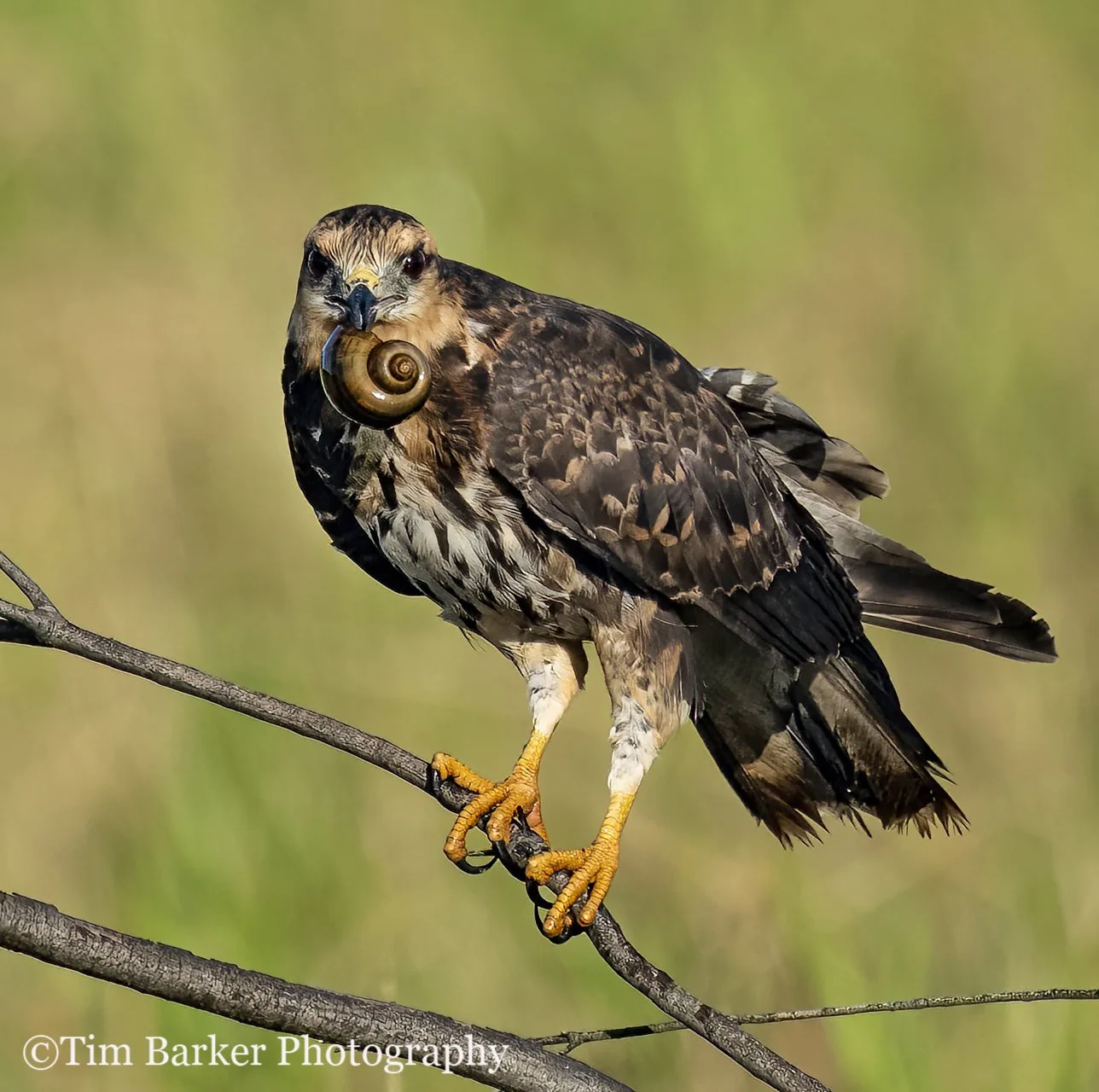
Hilary Flower is an associate professor of environmental studies at Eckerd College, where she studies the intersection of ecohydrology and climate change. Her first book is The Kite and the Snail: An Endangered Bird, Its Unlikely Prey, and a Story of Hope in a Changing World (University Press of Florida, 2026). In this interview, she discusses the snail kite’s remarkable story, the ecohydrology of the Everglades, and the environmental lessons we can learn.
How would you explain the subject of your book to someone unfamiliar with it?
The subject of the book is hope. We get a lot of doom and gloom in environmental news. Here's a raptor that has cheated extinction multiple times, because it's so incredibly adaptable. I think we can learn a lot from Everglade snail kites about working with changing conditions, especially in this age of climate change, sea level rise, invasive species, and other problems that we are not entirely equipped to handle.
More specifically: a raptor almost went extinct until an invasive species came along! This story really turns conservation ideas on their head. The Everglade snail kite relied on the Florida apple snail, but it started to decline in the Everglades due to problems with water management. The Everglade snailkite only eats apple snails, so the snail kite population was plummeting in the early 2000s. Then along comes a non-native snail and it starts exploding in population in the central part of the state, hundreds of miles from the Everglades. And the snail kite moved out of the Everglades and started relying on the new snail! Snail kite numbers have recovered to about 3,000.
There's a lot of hope in watching an endangered species save itself. They are still very vulnerable, and so the question now is: Can we humans and our systems become flexible and nuanced enough to help the snail kites survive for decades to come?
How did you become interested in Everglade snail kite? Why do you think more people should know its story?
I am an ecohydrologist, which means my research focuses on the connection between water and wildlife. Snail kites are the poster child for this: For millennia, they relied entirely on the Florida apple snail, which depends on water levels being just right (high at the right times, but not too high; low at the right times, but not too low). So when the water was right, snail kites abounded! And when the water management became too deep and too dry in recent decades, the Everglade snail kite had to leave the Everglades and switch to a non-native snail that likes invasive plants and impacted lakes and canals. The snail kites can tell us so much about ecohydrology, how restoration is doing, and what we need to change.
Was this a book you had been planning to write for a while, or is it especially relevant to the present moment?
I got the idea for the book and suddenly plunged into the project for the next two years. I was excited about it because I've been thinking a lot about our present moment: We are trying to restore landscapes and their wildlife, and new challenges are starting to take their toll (e.g., sea level rise and climate change). Now more than ever, we need to think on our feet, take into account what's happening right now, and improvise! And the snail kites are a great role model. Plus, because they are so adaptive, their story is full of surprises, mysteries, and twists and turns!
What did the research look like for this book? How did you get it done?
As an outsider to the world of snail kites, it was really a journey into the unknown for me. And I was excited to take the reader along for the ride! I had so many questions, and the answers were fascinating, and raised even bigger questions. I read the peer-reviewed literature, reached out to experts, and got out in the field with people trying to save snail kites. It helped me really see the snail kites through the eyes of those trying to save them.
What is your relationship with Florida? What connection do you have to the state?
Ha! I moved here from California in 1997 wondering how I would survive without mountains! I ended up falling in love first with the coastal ecosystems, and then the Everglades. Following the snail kites around opened up parts of Florida I had never known existed, or at least never been to: a cattle ranch, an abandoned mining pit, stormwater treatment areas, and a magical preserve I had never heard of called Grassy Waters. The snail kites taught me that they need what I came to think of as "the two Floridas" - they need the Everglades and other preserves, and they need human-dominated wetlands. So we need to focus on recovering the Everglades, and also making room for them in our human-dominated wetlands.
What role does the Everglades play in the snail kite’s story? What makes this environment so unique?
The snail kite is named for the Everglades because it evolved over the millennia to thrive on what was abundant historically: clear, shallow water, lots of Florida apple snails. These have been lost in the Everglades south of Lake Okeechobee, and it's a real wake-up call to Everglades Restoration: the ecosystem is not working for the snail kites, wading birds, mammals, etc. Grassy Waters Preserve in the City of West Palm Beach is a slice of the historical Everglades that has never been damaged, and that's one of the few places today where you still see the snail kite foraging on the Florida apple snail. We can't rely on the non-native snail to sustain the snail kites forever. We need to put some of our human agendas into better balance with ecosystem health.
Are there any other stories you’re interested in telling? Do you have ideas for your next project?
My new project is on flamingos in Florida! Lots of people do not realize they are native; in fact, the Florida Fish and Wildlife Commission website listed them as non-native up until 2018. It turns out there are loads of accounts of seeing flamingos in Florida - sometimes flocks of thousands! - until we hunted them out for meat (yes, roasted flamingo) or plumes (for ladies’ hats). As flamingos are starting to come back of their own accord, we have an opportunity for radical repair: reckoning with our violent past, and our damaged relationship with nature. And who knows? We could once again see flocks of thousands of flamingos on our beaches. It's a future we can create!
What other books would you recommend to ecologically interested readers?
Wild Souls: Freedom and Flourishing in the Non-Human World by Emma Marris digs into our ethically fraught relationship with wildlife, and how it has shaped us. She loves to challenge rigid conservation ideas. I don't agree with everything but I find it invigorating exploring this territory through her writing.
The Sound of the Sea: Seashells and the Fate of the Oceans by Cynthia Barnett takes something seemingly commonplace, seashells, and uses them to open out a world of new understanding about oceans, the creatures that live in them, and what we can learn from them.
Anyone interested in Florida wildlife should pick up any Craig Pittman book! My favorite is Cat Tale: The Wild, Weird Battle to Save the Florida Panther.
Interview conducted by Lydia Kuerth