Saturday Shortstack
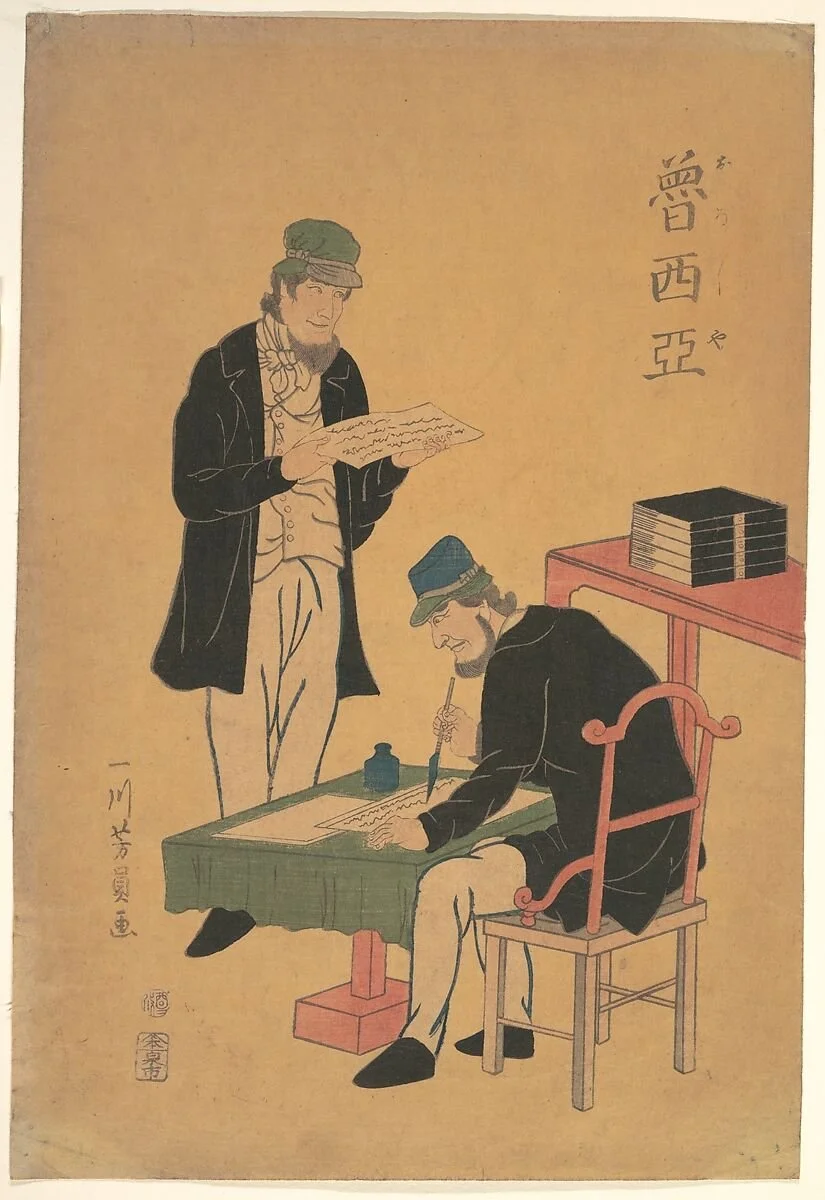
“Russians Reading and Writing” by Utagawa Yoshikazu
Turkmenistan, Where on Earth is That? by Tam Macklin (Rowanvale Books, 2025)
Turkmenistan has the largest indoor Ferris wheel and the highest concentration of marble buildings, but you are not likely to see those things because it is one of the most closed countries in the world. It’s hard to know much about Turkmenistan, but you will know a little bit more if you read this book.
Tam Macklin is a British helicopter pilot who spent time in ex-Soviet Turkmenistan teaching some of their pilots how to fly AW139 helicopters. Macklin found most of the people he was around to be happy enough, but his observations include enough not-so-secret state police, restrictions, and evidence of an extremely controlled society to make clear how significant some of the differences are between Turkmenistan and most Western countries. After all, “in some cases, any dissent could mean arrest and jail time” (247). This book focuses primarily on his experiences flying and training Turkmen pilots.
Turkmenistan, Where on Earth is That? is one of few first-hand accounts of Turkmenistan you will come across, but it is also an interesting account of the author’s life and helicopters. Though not exactly in the style of memoir, this is the kind of book that Mike Rowe of Dirty Jobs would love, with its narrative of a working-class boy becoming a military serviceman and eventually a helicopter pilot. A book about helicopters is about as rare as an account of Turkmenistan. This book compares types of helicopters, describes their operations, gives an account of flying them, and really takes you into the cockpit. You’re still not in the simulator, but you’re closer than you would otherwise be and you should have a better understanding of what it takes to operate a helicopter.
Is Your Work Worth It? How to Think About Meaningful Work by Christopher Wong Michaelson and Jennifer Totsi-Kharas (Hachette, 2024)
This is one of those books that compiles a range of studies and synthesizes the findings to present a coherent picture. The authors, a philosopher and a psychologist, share stories of people and their work and offer questions and evidence “that may help you answer whether your work is worth it” (14). The intent is to be helpful by giving us the tools to interpret our relationship to our work and to decide what kind of work we want to have. It covers everything from the hedonic treadmill to the pros and cons of “calling” to the relationship between work and compensation, with references to studies and historical figures.
The authors hope “this book has helped you contemplate how you want to live your life and what role work will occupy” and that the book inspires us “to think about a higher purpose, a better future, and your lasting legacy” (242). That may seem ambitious for a book whose genre is not dissimilar from an extended podcast. But despite not being especially philosophical or theological, a book like this can still be significant to readers, because it rightly emphasizes the importance of work in how we understand ourselves and our place in the world. We will need more of this and more Studs Terkel (who is referenced here) as we face the dramatic changes that are coming to work thanks to AI and the people who challenge the value of work altogether. Work, as a whole, is a meaningful part of the human experience and we need all the help we can get for thinking about it and its worth.
Unreasonable Hospitality: The Remarkable Power of Giving People More Than They Expect by Will Guidara (Optimism Press, 2022)
In case you missed it, Unreasonable Hospitality is a bestseller by the restauranteur and hospitality expert who took Eleven Madison Park to number one. He is also a co-producer of The Bear and if you can recall the most recent season and the emphasis on near-magical experiences for guests, you will recognize the spirit which animates Guidara and this book.
This book is a great read for the story of Guidara’s career in the restaurant business and what food and serving food has meant to him. It’s a good example of achieving excellence in the field and what it takes and looks like. (If you like Danny Meyer, you’ll like this one.) This book is also a great read for anyone who wants to understand how to have a strong, positive workplace culture which is transformative for employees and offers an experience for customers that exceeds the transactional. It would be great in a business class and you would love your boss to read it.
Even if you don’t care much about restaurants or business, if you’re the kind of person who likes Chick-Fil-A’s “second mile service,” you should read this book. It is filled with insights into the nature of hospitality and how to make someone feel special (and why we should). If you don’t come away with some examples and ideas for unreasonable hospitality that can apply in your own circumstances, you skimmed it at best.
